

In today’s fast-paced business environment, access to timely and accurate information is more critical than ever. On-demand information services have emerged as a vital resource, providing businesses with the specific data and insights they need, exactly when they need them. These services cater to a wide range of requirements, from market research and competitive intelligence to data analysis and knowledge management, empowering organizations to make informed decisions and gain a competitive edge. This article explores the concept of on-demand information services, their benefits, implementation, and future trends.
Understanding On-Demand Information Services
On-demand information services are designed to provide users with instant access to information and resources tailored to their specific needs. Unlike traditional information services, which may involve lengthy processes and fixed subscriptions, on-demand services offer flexibility, scalability, and immediate results. These services are typically delivered through user-friendly digital platforms, allowing businesses to request and receive information quickly and efficiently.
Key characteristics of on-demand information services include:
- Customization: Information is tailored to meet the unique requirements of each business.
- Accessibility: Services are available anytime, anywhere, through digital platforms.
- Scalability: Businesses can easily scale their usage up or down based on their needs.
- Cost-Effectiveness: Pay-as-you-go models reduce the need for substantial upfront investments.
The primary goal of these services is to provide businesses with the right information at the right time, enabling them to make better decisions, improve operational efficiency, and drive growth.
The Rise of the On-Demand Economy
The on-demand economy has experienced explosive growth in recent years, driven by evolving consumer expectations and technological advancements. This trend has extended beyond traditional consumer services like ride-hailing and food delivery to encompass a wide range of business-oriented solutions, including information services. The increasing availability of high-speed internet, mobile devices, and cloud computing has made it easier than ever for businesses to access and utilize on-demand services.
Several factors have contributed to the rise of the on-demand economy:
- Demand for Instant Gratification: Businesses and consumers alike expect immediate access to goods, services, and information.
- Technological Advancements: Mobile apps, cloud computing, and data analytics have made on-demand services more accessible and efficient.
- Cost Savings: On-demand services often eliminate the need for significant upfront investments and ongoing maintenance costs.
- Flexibility and Scalability: Businesses can easily adjust their usage of on-demand services to meet changing needs.
The on-demand economy is transforming the way businesses operate, creating new opportunities for innovation, growth, and competitive advantage. Adapting to this changing landscape requires a willingness to embrace new technologies and business models.
The Role of Technology in On-Demand Services
Technology is the backbone of on-demand information services, enabling seamless delivery, efficient processing, and personalized experiences. Key technological components include:
- Mobile Apps: User-friendly apps allow businesses to request and access information on the go.
- Cloud Computing: Cloud-based platforms provide scalable storage and processing power.
- Data Analytics: Advanced analytics tools enable the collection, analysis, and interpretation of vast amounts of data.
- Artificial Intelligence (AI): AI-powered algorithms can automate tasks, personalize recommendations, and improve decision-making.
For example, AI can be used to analyze market trends, identify potential risks and opportunities, and provide businesses with actionable insights. Data analytics tools can help businesses understand customer behavior, optimize marketing campaigns, and improve product development. The integration of these technologies creates a powerful ecosystem that enables businesses to leverage information more effectively than ever before.
Types of On-Demand Information Services
On-demand information services encompass a wide range of solutions tailored to meet specific business needs. Some of the most common types include:
Market Research Services
These services provide businesses with valuable insights into market trends, customer preferences, and competitive landscapes. On-demand market research can help businesses identify new opportunities, assess the viability of new products or services, and refine their marketing strategies.
Competitive Intelligence
Competitive intelligence services offer businesses a comprehensive understanding of their competitors’ strategies, strengths, and weaknesses. This information can be used to develop more effective competitive strategies, identify potential threats, and capitalize on market opportunities.
Data Analysis Services
Data analysis services help businesses make sense of the vast amounts of data they collect. These services can be used to identify trends, patterns, and correlations that can inform decision-making and improve operational efficiency.
Knowledge Management Solutions
Knowledge management solutions provide businesses with the tools and processes they need to capture, store, and share knowledge effectively. These solutions can help businesses improve collaboration, reduce redundancy, and enhance innovation.
Legal and Regulatory Information
Access to up-to-date legal and regulatory information is crucial for businesses operating in regulated industries. On-demand services can provide businesses with the information they need to comply with relevant laws and regulations, reducing the risk of fines and penalties.
Financial Information Services
These services offer real-time access to financial data, market analysis, and investment recommendations. They are particularly valuable for businesses that need to make informed financial decisions quickly.
On-Demand Training and Education
Businesses can use on-demand platforms to provide employees with training and educational resources tailored to their specific roles and responsibilities. This can improve employee skills, boost productivity, and reduce the need for costly in-person training programs.
Benefits of On-Demand Information Services for Businesses
On-demand information services offer a wide range of benefits for businesses of all sizes. Some of the most significant advantages include:
- Improved Decision-Making: Access to timely and accurate information enables businesses to make better decisions.
- Increased Efficiency: Streamlined processes and automated tasks improve operational efficiency.
- Reduced Costs: Pay-as-you-go models eliminate the need for significant upfront investments and ongoing maintenance costs.
- Enhanced Competitiveness: Access to market research and competitive intelligence helps businesses stay ahead of the competition.
- Greater Flexibility: Businesses can easily scale their usage of on-demand services to meet changing needs.
- Better Customer Insights: Data analysis tools provide valuable insights into customer behavior and preferences.
Challenges and Considerations
While on-demand information services offer many benefits, there are also some challenges and considerations that businesses need to be aware of. These include:
- Data Security: Protecting sensitive data is crucial when using on-demand services.
- Data Quality: Ensuring the accuracy and reliability of information is essential for making informed decisions.
- Integration: Integrating on-demand services with existing systems can be complex and require careful planning.
- Vendor Management: Choosing the right vendor is critical for ensuring the success of on-demand information services.
Businesses need to carefully evaluate these challenges and implement appropriate safeguards to mitigate potential risks. Data security measures, such as encryption and access controls, are essential for protecting sensitive information. Data quality can be improved by implementing rigorous data validation and cleansing processes. Integration challenges can be addressed by working with vendors that offer seamless integration capabilities.
Implementing On-Demand Information Services
Implementing on-demand information services requires careful planning and execution. Here are some key steps to consider:
- Identify Information Needs: Determine the specific information requirements of the business.
- Evaluate Available Services: Research and evaluate different on-demand information services.
- Select a Vendor: Choose a vendor that offers the right services, technology, and support.
- Develop an Implementation Plan: Create a detailed plan for integrating on-demand services with existing systems.
- Train Employees: Provide employees with the training they need to use on-demand services effectively.
- Monitor and Evaluate: Continuously monitor and evaluate the performance of on-demand services to ensure they are meeting business needs.
A well-defined implementation plan can help businesses avoid common pitfalls and maximize the benefits of on-demand information services. Employee training programs are essential for ensuring that employees have the skills and knowledge they need to use these services effectively.
Future Trends in On-Demand Information Services
The on-demand information services market is expected to continue to grow rapidly in the coming years, driven by technological advancements and evolving business needs. Some of the key trends to watch include:
- Increased Use of AI and Automation: AI and automation will play an increasingly important role in delivering personalized and efficient information services.
- Greater Focus on Data Analytics: Data analytics will become even more critical for helping businesses make sense of the vast amounts of data they collect.
- Expansion of Service Offerings: On-demand information services will expand to encompass a wider range of solutions, including specialized consulting and advisory services.
- Integration with IoT Devices: The Internet of Things (IoT) will enable more seamless and integrated information services.
Businesses that embrace these trends will be well-positioned to leverage on-demand information services to drive growth, improve efficiency, and gain a competitive edge. The convergence of AI, data analytics, and IoT will create new opportunities for innovation and value creation.
Conclusion
On-demand information services are transforming the way businesses access and utilize information. By providing instant access to tailored data and insights, these services empower organizations to make better decisions, improve operational efficiency, and drive growth. As technology continues to evolve, on-demand information services will become even more essential for businesses seeking to thrive in today’s dynamic and competitive environment. Embracing these services requires a strategic approach, careful planning, and a commitment to continuous improvement.
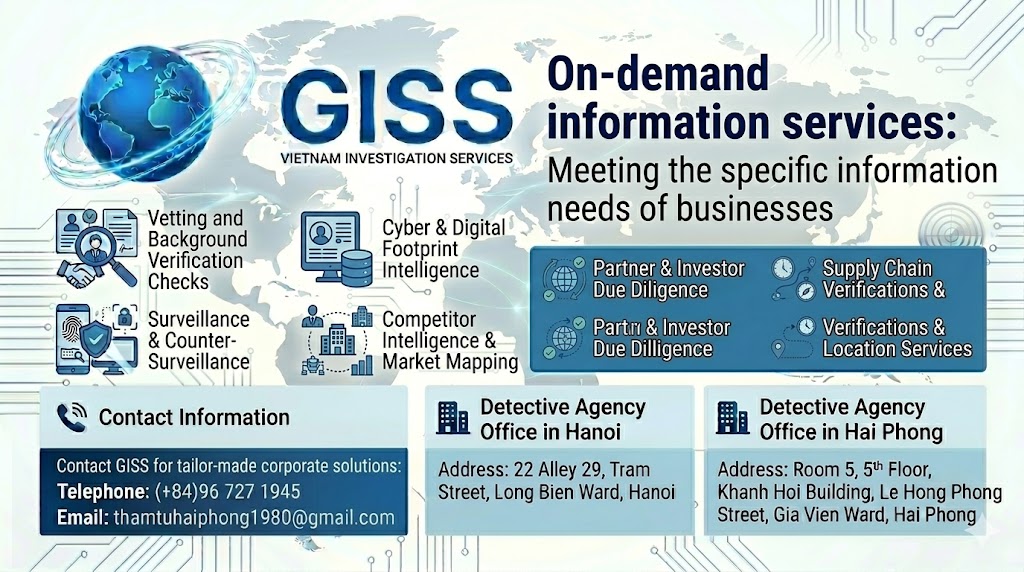
GLOBAL INFORMATION SUPPLY SERVICES COMPANY LIMITED (GISS CO.,LTD)
Contact Info Tel: (+84)96 727 1945 Email: thamtuhaiphong1980@gmail.com
DETECTIVE AGENCY OFFICE IN HANOI Address: 22 Alley 29, Tram Street, Long Bien Ward, Hanoi
DETECTIVE AGENCY OFFICE IN HAI PHONG Address: Room 5, 5th Floor, Khanh Hoi Building, Le Hong Phong Street, Gia Vien Ward, Hai Phong